
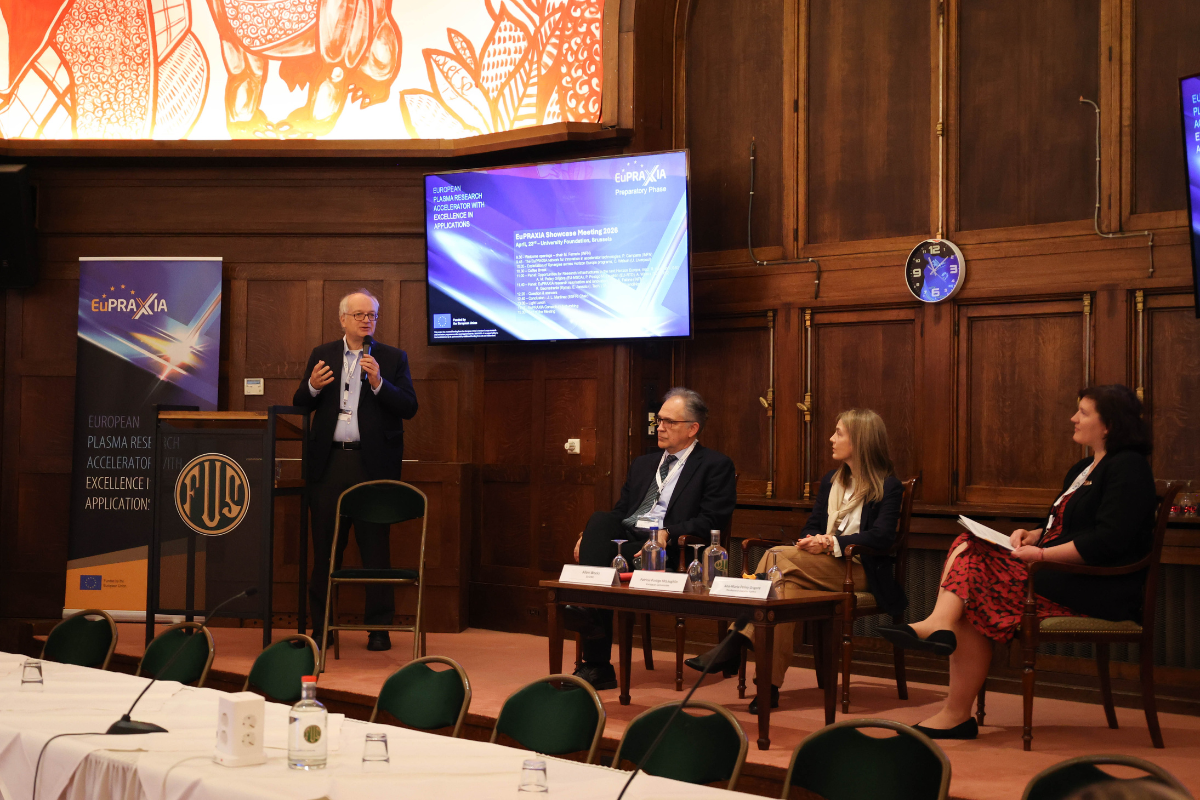
Developing a disruptive particle accelerator technology in Europe is only possible through collective efforts, consolidation and a long-term vision, according to speakers at a Brussels event showcasing the EuPRAXIA project, which aims to build the world’s first plasma-based accelerator facility for users.
The event, which took place on April 23, brought together several key members of Europe’s research infrastructures community to discuss various aspects of EuPRAXIA, and how the project connects to the EU’s increasing emphasis on technological competitiveness. It was organised by INFN National Laboratory of Frascati (LNF) in Italy and the University of Liverpool in the UK.
“If you want to build something at scale, like EuPRAXIA, you absolutely have to have a mix of funding, from regional funds, national funds, European funds and even connections with industry. There's no way you can just count on one,” said Allen Weeks, director general at the Extreme Light Infrastructure (ELI), an international laser user facility that has some of the most intense lasers in the world.
The only way that Europe can compete globally is “to defragment”, Weeks added.
“Eupraxia is a microcosm of what Europe needs to do. We need to focus our resources on tackling a specific problem, and come together to solve it,” he said, speaking during a panel discussion at the event.
The EuPRAXIA project began in 2014 with EU funding that led to the publication of a conceptual design report for a plasma accelerator facility in 2019. Since then, several more projects have been funded, at a national and European level, aiming to develop the various technologies that would be needed for such a facility.
In 2021, EuPRAXIA was added to the European Strategy Forum on Research Infrastructures (ESFRI) roadmap, marking it as one of Europe’s most promising and important future research infrastructures.
Now, the LNF in Italy is constructing a new building to house the primary site of the plasma-based accelerator facility, with ELI’s Beamlines facility just outside Prague the second site. LNF is aiming to have the first pilot users in 2029.
José Luis Martínez, the chair of ESFRI, also spoke at the event and highlighted the need for research infrastructures to strongly consider sustainability going forwards.
“We are trying to give the message to European research infrastructures to collaborate more between them, in order to consolidate the present ecosystem of RI in a more strategic way, as a consequence trying to use what we already have before building something completely new,” he said.
He added that EuPRAXIA was a good example of this with the collaboration it has created between LNF and ELI.
“It will be necessary for the future in Europe to explore even further the [ways in which existing research infrastructures can work together], as a path to achieve a sustainable ecosystem of RI,” he said.
Technology and infrastructure are not the only aspects where broader collaboration is needed. Carsten Welsch manages the EuPRAXIA Doctoral Network, which offers 12 fellowships to work across plasma accelerator research through Horizon Europe’s Marie Skłodowska-Curie Actions.
He said schemes like this are vital in training the next generation of talent who will, on the whole, be the ones in the position to use the technology as it develops over the coming decades.
“We have made a start in training the next generation, but that work has to continue and has to keep spanning disciplines so that we can really maximise the potential of plasma-based acceleration,” Welsch said.
EuPRAXIA’s disruptive technology
What makes plasma-based acceleration so promising is the potential to accelerate particles to very high energies over extremely short distances. The technology could miniaturise particle accelerators to such an extent that they could easily be installed in hospitals, universities, individual laboratories, or workshops. And, smaller accelerators theoretically mean cheaper accelerators.
There are around 30,000 particle accelerators in the world, and over 80% are used for radiotherapy to treat cancer or for manufacturing, in areas such as ion implantation or surface modification.
And while the huge accelerators principally used for scientific research, such as CERN’s Large Hadron Collider (LHC), are arguably the most impressive due to their scale and complexity, only around 2% of global accelerators are used for high-energy physics or research.
So, the impact of plasma acceleration leading to smaller and cheaper particle accelerators would be significant for society and industry.
It works in a very different way to the more conventional accelerators in use today. Machines such as the LHC use metal radio-frequency cavities to produce an electric field that, with oscillating electromagnetic waves, continuously push particles forwards. But metal structures can only tolerate a certain electric field strength before electrical breakdown occurs, so to reach extremely high energies, a very long machine is needed. This explains why the LHC is 27km long.
Plasma-based accelerators don’t need RF cavities. They take a plasma – think of it as a sort of soup of positive ions and free electrons – and inject a very intense pulse into the plasma, either with a high-powered laser or a very energetic particle beam. That pulse pushes plasma electrons aside, creating a moving disturbance behind it, which is similar to a wake that occurs behind a speedboat. Inside that wake are extremely strong electric fields on which a second bunch of particles surfs at a speed close to that of light.
The result is that what could take kilometres in a conventional accelerator to reach certain energies might only take metres in a plasma accelerator.
Industry ties vital
While it is recognised that this technology is still quite far from being adapted for high-energy physics research, in the way that the LHC does, it could prove revolutionary for other accelerator-based applications in the coming decades.
“I think the impact this technology could have is underestimated,” said Weeks, adding that there is a “feeling it can be a truly disruptive innovation”.
Mikael Lindholm, senior vice president for global sales and business development at ScandiNova, a Sweden-based company specialising in the development and production of high-voltage pulse generators, agreed.
“EuPRAXIA is technologically a game changer, I see a number of applications where it could be used,” he said, speaking on a panel focused on the links to industry.
ScandiNova supplies products to many of the world’s accelerator facilities
“For us, EuPRAXIA’s technology will push us to the next level. When people went to the Moon, someone had to be the first, and that’s what EuPRAXIA is doing,” he added.
Raffaella Geometrante, managing director of Italian spin-off Kyma, which develops and produces advanced high-tech permanent magnet devices for accelerator facilities and laboratories, spoke on the same panel.
She also stressed the fact that collaboration between industry and science is essential to develop innovative new technologies such as those needed by EuPRAXIA.
“If we want to innovate, we cannot come in cold later,” she said. “If we, as industry partners, are involved early, it allows us to go much faster. EuPRAXIA is creating such a kind of environment in which you can have that approach.”
It will also benefit European competitiveness, she said.
“It creates an independent technological base that will remain a European competence.”