
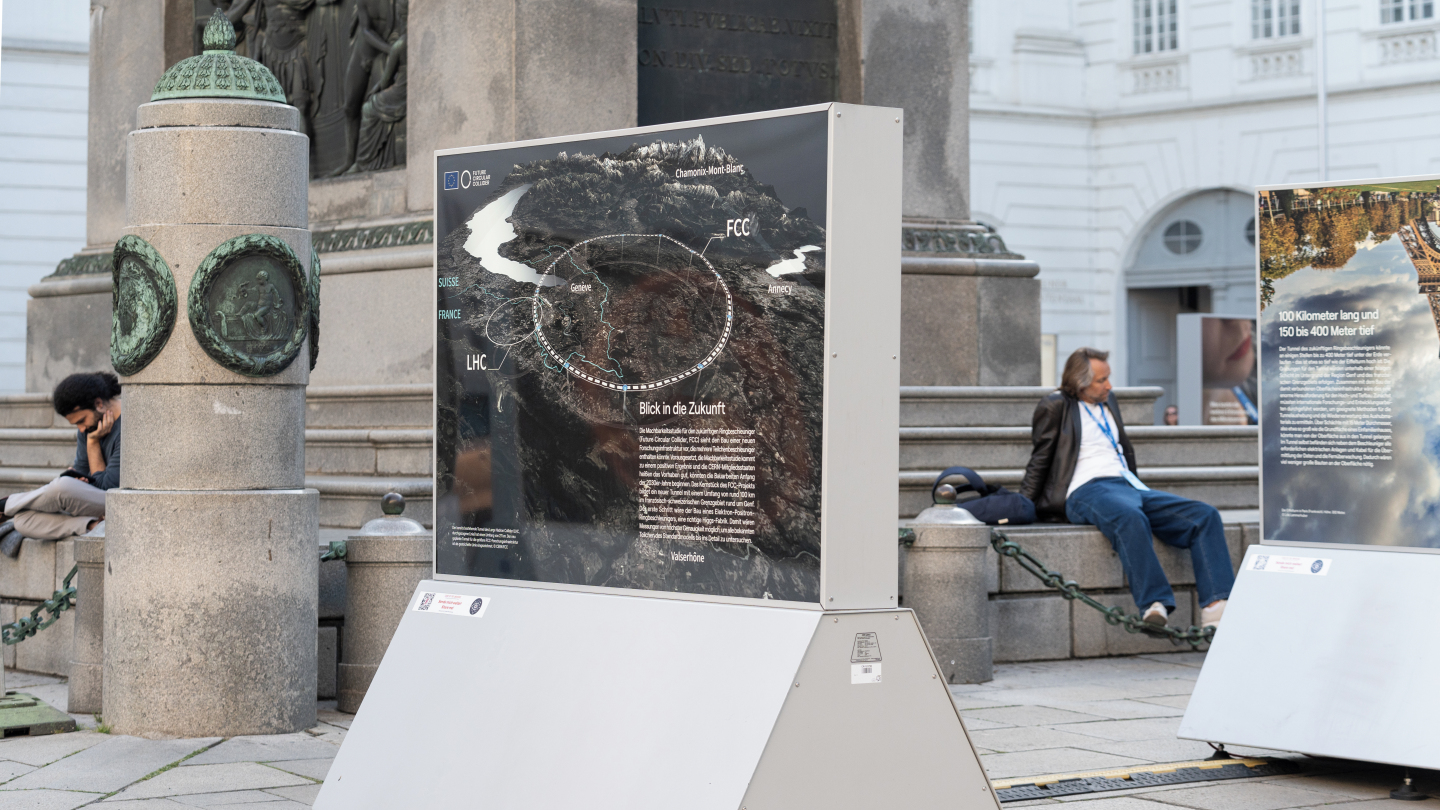
The proposed 90.7km electron–positron Future Circular Collider (FCC-ee) has been recommended to be CERN’s next flagship accelerator by the European Strategy Group (ESG), CERN announced last Friday, 12 December.
The ESG was tasked by the CERN Council to put forward its preferred choice for an accelerator to succeed the Large Hadron Collider (LHC) – set to be retired by the end of 2041 – as part of the ongoing update to the European Strategy for Particle Physics (ESPP).
The ESG’s decision was based on input to the ESPP update by the particle physics community.
“During the strategy process we have seen a very strong engagement of the European particle physics community and beyond, expressing their views on the next flagship collider, on other physics and technology areas and topics of importance for our field,” said Karl Jakobs, chair of the Strategy Secretariat.
“In addition, many other important recommendations have been made for the future of our field,” added Jakobs, who is a professor of particle physics at the University of Freiburg and formerly the spokesperson for the ATLAS Collaboration at CERN’s LHC.
The ESG’s recommendations on a future accelerator project at CERN make up a part of the update of the ESPP, which will be finalised in a meeting in May 2026. The ESPP is updated every five-to-seven years and sets the mid- and long-term roadmap for particle physics in Europe and beyond.
The FCC-ee recommendation will feed into the CERN Council’s final decision, expected in 2028, on which future accelerator project to pursue.
Why the FCC-ee was recommended
The FCC-ee is the first stage of a proposed long-term accelerator project at CERN.
The idea is for the FCC-ee, named so as it would collide electrons with their anti-matter equivalent, positrons, to be constructed and in operation by the late 2040s. This would provide a relatively seamless transition from the end of the high-luminosity era of the LHC.
The second stage, called the FCC-hh, would collide protons, as well as heavy ions, similar to CERN’s current LHC but capable of producing significantly more collisions at far higher energies. This accelerator would begin operation in the 2070s and would run until around the end of the century. The new ESG recommendations acknowledge the second phase of the FCC project, stating that building the FCC-ee would “pave the way” towards a hadron collider using the same tunnel and infrastructure.
The FCC-ee would “deliver the world’s broadest high-precision particle physics programme, with an outstanding discovery potential through the Higgs, electroweak, flavour and top-quark sectors, as well as advances in quantum chromodynamics, the ESG recommendations state.
It adds that the project would “maintain European leadership in high-energy particle physics, as well as advancing technology and providing significant societal benefits”.
The ESG also named a “descoped FCC-ee” as its preferred second choice, should the FCC-ee not get the needed backing.
This could mean several things. One suggestion would be to remove the “top-quark run”. The FCC-ee as it is planned includes four operational phases, each designed to test different aspects of physics, so removing one phase would simplify the project but would mean the breadth of the physics programme offered by the FCC-ee would be reduced.
Other possibilities would be to build two, rather than four, collision points and experiments, or decrease the radiofrequency (RF) system power of the accelerator. These measures would reduce the construction cost by approximately 15%, the recommendations state. The FCC-ee is estimated to cost around CHF15 billion.
Related reading: A look at the Future Circular Collider (FCC) study at CERN
Other accelerator projects
Several other future accelerator projects were proposed as part of the input to the ESPP update. This includes the Compact Linear e+e− Collider (CLIC), the Muon Collider, the Linear Collider Facility (LCF), LEP3: A High-Luminosity e+e− Higgs & Electroweak Factory, and the Large Hadron electron Collider (LHeC).
Related reading: How do CERN’s future proposed flagship accelerator projects compare?
On CLIC and LCF, the ESG states that they offer “substantially reduced precision physics programmes and would not be competitive with a collider like the FCC-ee”.
Related reading: A look at the proposal for a Compact Linear Collider at CERN
LEP3 and the LHeC would offer “an intermediate physics programme at significantly lower construction costs than the other options” but neither on their own would “be a flagship collider”.
“To provide a long-term physics programme, they would need to be complemented by an energy-frontier machine, such as a hadron collider,” the ESG recommendations state.
The report suggests supporting technologies underpinning muon beams and states that synergies with the US on muon collider R&D should be exploited, but does not mention the muon collider as a potential accelerator at CERN.