
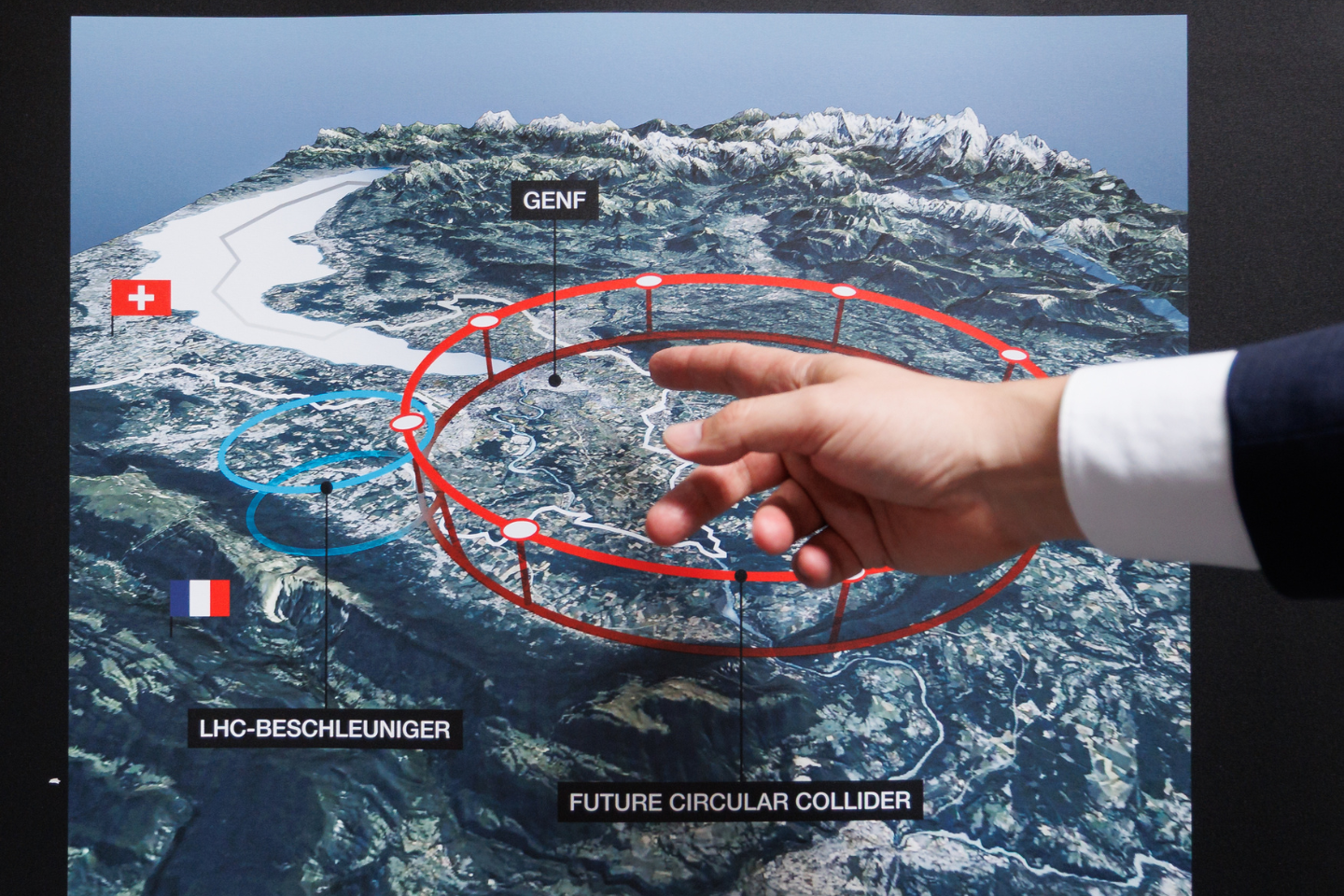
The Future Circular Collider (FCC) is a proposed two-stage, 90.7km next-generation particle accelerator put forward to replace CERN’s Large Hadron Collider (LHC) when it is retired in the 2040s.
The first stage of the FCC is named the FCC-ee as it would collide electrons with their anti-matter equivalent, positrons. This accelerator is planned to be in operation by the late 2040s. The second stage, called the FCC-hh, would collide protons, as well as heavy ions, similar to CERN’s current LHC but capable of producing significantly more collisions at far higher energies. This accelerator would begin operation in the 2070s and would run until around the end of the century.
A huge amount of work has already been done to shape the FCC project, including an extensive feasibility study. This study, along with others explaining the FCC project, was recently submitted as input to the European Strategy for Particle Physics Update (ESPPU) as part of a process to choose a future, flagship particle accelerator project at CERN.
In this interview, Frank Zimmermann, senior scientist in CERN’s Beams Department and deputy leader of the FCC study, offers his insights into the background of the FCC, what new physics could come from the two accelerators, the benefits they would have for industry and society, and why the scientific community needs such a project now.
You can read similar interviews with representatives of the Compact Linear Collider (CLIC) project here, and the Muon Collider project here, two other proposed future accelerators. You can also read an interview with a group that recently published a comparison study of six of the proposed future accelerators here.
*This interview was carried out before the electron–positron Future Circular Collider (FCC-ee) was announced, on 12 December, as the preferred option of the European Strategy for Particle Physics (ESPP) to be CERN's next flagship collider. Read more about the announcement here.
What is the FCC project, and what is its current status?
The Future Circular Collider (FCC) is a proposed next-generation particle accelerator programme to succeed the presently operating Large Hadron Collider (LHC). It envisions a new 90- km tunnel that would first host a high-luminosity electron–positron collider (FCC-ee) and later a highest-energy proton–proton collider (FCC-hh). The FCC Feasibility Study launched by the CERN Council in 2021, was successfully concluded in March 2025. This Feasibility Study (FS) confirmed the project’s technical viability and outlined the next steps toward a detailed technical design phase. The FS report has informed the recent discussions on the 2026 update of the European Particle for Particle Physics. Current design efforts focus on improving cost estimates, strengthening environmental planning, and developing a clear and robust implementation strategy.
Why is the FCC structured in two phases, and what distinguishes them?
The FCC is conceived as an integrated, two-phase programme designed for maximum scientific reach and optimum efficiency in terms of overall construction cost and shared infrastructure. The first stage, FCC-ee, will be a highest-luminosity electron–positron collider operating around four key centre-of-mass energies: the Z pole, the WW pair production threshold, the ZH production peak, and the top-antitop threshold, spanning a centre-of-mass energy range from 90 to 365 GeV. During roughly 15 years, it will deliver the world’s most precise measurements of electroweak, Higgs, and top-quark properties, producing over 6 trillion Z bosons, 200 million WW pairs, nearly 3 million Higgs bosons, and top-quark pairs. Frequent resonant depolarisation will ensure ultra-precise calibration of beam energy, which is critical for per-mil-level tests of Standard Model parameters.
The second stage, FCC-hh, will reuse the same 90- km tunnel and much of the technical infrastructure for accommodating a proton–proton collider, FCC-hh, operating at about 85 TeV centre-of-mass, which will extend the energy frontier by almost an order of magnitude beyond the LHC. FCC-hh will deliver an integrated luminosity about 10 times higher than the high-luminosity upgrade of the HL-LHC (set to be in operation from 2030), enabling direct exploration of new heavy particles and interactions. This staged strategy ensures early physics returns, spreads the cost and complexity, and provides the long timeline needed to advance key technologies for FCC-hh such as high-field superconducting magnets, highly efficient cryogenics, and a sustainable infrastructure.
What would the FCC allow us to explore, in terms of physics?
The discovery of the Higgs boson completed the Standard Model; yet it also exposed its limitations. Key questions remain unanswered — the nature of dark matter, the origin of the matter–antimatter asymmetry, and the stability of the Higgs field itself. Addressing these challenges requires a new experimental tool capable of exploring both precision and energy frontiers with unprecedented reach.
The FCC-ee will provide the cleanest conditions ever achieved in high-energy collisions, enabling precise measurements of the Z, W, Higgs, and top quark with accuracies orders of magnitude beyond today’s capabilities. Operating at several centre-of-mass energies, it will map the properties of the Higgs boson and electroweak particles, search for rare or invisible decays, including into right-handed sterile neutrinos, and probe new physics indirectly through subtle deviations from Standard Model predictions.
The subsequent FCC-hh phase will extend direct exploration to the 10s of TeV scale, producing enormous samples of Higgs bosons and enabling searches for new heavy states, extended Higgs sectors, and dark-sector particles. Together, these two stages will deliver the most comprehensive exploration of particle physics ever undertaken — connecting precision and discovery in a single, long-term programme, that can reveal the mechanisms which shaped the early universe and the laws that govern its evolution.
What are the main technical challenges of the FCC project?
The FCC (Future Circular Collider) project faces several major technical challenges, with the immediate focus on FCC-ee, whose design parameters imply significant levels of synchrotron radiation power, calling highly efficient RF power sources, dedicated discrete photon absorbers, and advanced thermal management, including local reuse of some of the waste heat. In parallel, essential groundwork for the overall FCC infrastructure is underway: the 91-km tunnel and related facilities demand careful civil-engineering planning. The ongoing site investigations and geological surveys around the Geneva region are already providing crucial data that will help optimize positioning, mitigate risks, and support a smooth transition to construction. Looking ahead to the later FCC-hh phase, achieving the required 16 Tesla superconducting magnets remains a major challenge; this is being addressed through the High Field Magnet Programme, which unites multiple laboratories and industrial partners to advance both Nb₃Sn and HTS technology and prepares for large-scale production. Across both stages, the project also requires innovations in power management, cryogenics, beam dynamics, machine protection, and radiation-hard detectors. The challenges are substantial but are being actively tackled through coordinated international R&D efforts.
What is the overall timeline of the project?
Following completion of the Feasibility Study in 2025, a decision by CERN’s Member States and international partners on which future accelerator project will be pursued is expected around 2028. Subject to approval at that time, construction of the tunnel and technical infrastructure could begin in the early 2030s. The first phase, FCC-ee, would aim to begin operations in the late 2040s and would span approximately 15 years. This would be followed by a conversion to FCC-hh, with commissioning in the mid-2070 and operations extending through the end of the 21st century. This timeline ensures scientific and technical continuity for the global particle physics community in the post-LHC era.
Why does the scientific community need the FCC — and why now?
The discovery of the Higgs boson at the LHC marked a major breakthrough, but it also highlighted how many fundamental questions remain unanswered — from the Higgs boson’s own properties over the nature of dark matter, and the origin of the matter–antimatter imbalance, to the limitations of the Standard Model. The FCC aims to tackle these open questions by combining unprecedented measurement precision with record-setting collision energies as part of an integrated programme. As a unique long-term infrastructure, it will recycle and expand existing CERN facilities, offering an exciting scientific programme that advances the frontiers of human knowledge at least until the end of the 21st century. Building on the experience and lessons from the preceding, highly successful LEP–LHC programme, the FCC provides the continuity needed to advance key technologies, train future generations, and push the boundaries of accelerator design and detector science. Starting now ensures that Europe maintains its global leadership in high-energy physics and accelerator technologies, preserves critical expertise, and remains at the forefront of discovery for decades to come.
Who is behind the FCC project?
The FCC is an international collaboration hosted by CERN. At present it includes about 180 institutes and laboratories from nearly 40 countries. Participants span universities, national research organisations, international organisations, and funding agencies. Industrial partners are contributing to accelerator physics, detector design, civil engineering, and environmental assessment. The FCC collaboration is governed through dedicated working groups, international boards, and advisory committees, ensuring alignment with CERN’s European and global research strategy. This structure reflects the FCC’s role and set-up as a truly global scientific endeavour.
What new technologies could emerge from the FCC that might benefit society?
The FCC’s technological ambitions drive innovation with broad industrial, societal and economic impact. Advances in superconducting (SC) materials, cables, and magnets, including ones based on high-temperature superconductors, more efficient cryogenics, lower-loss or higher-temperature SC radiofrequency (RF) cavities and efficient RF power sources such as novel two-stage multi-beam klystrons and even more promising tristrons, as well as next-generation detector technologies, are expected to yield significant benefits beyond particle physics — ranging from medical imaging and quantum applications to cleaner and more efficient energy systems.
Developments in data processing, artificial intelligence, and large-scale sustainability design will also have wide-reaching applications and make a great impact. Within this framework, results from the Open Sky Laboratory at LHC Point 5 will help transform the FCC infrastructure into a platform for new technologies and cross-disciplinary research, strengthening collaboration between science and industry in multiple diverse domains. The FCC Feasibility Study outlines goals for energy reuse, low-carbon construction, and digital integration, positioning the project as a global model for sustainable and openly collaborative large-scale research infrastructure.
Why is the FCC the best option as a future accelerator for Europe?
The FCC represents a coherent and cost-effective strategy for Europe’s next major research infrastructure, combining precision measurements, high-energy exploration, and long-term scientific continuity within a single, integrated project. Its staged design allows for early scientific results while preparing the ground for future breakthroughs, and its implementation at CERN builds on decades of technical expertise and collaboration.
The Feasibility Study has confirmed the project's technical viability. Iterative improvements in civil-engineering design, extensive subsurface investigations, and comprehensive environmental assessments all demonstrate that the FCC can be realised through a technically feasible, territorially compatible, and economically sound approach. The socio-economic impact analysis reveals a positive benefit–cost ratio, even under conservative assumptions, underscoring the project’s value not only for science, but also for industry and society. The FCC will also reinvigorate joint pan-European research and development and foster peaceful international collaboration.
In conclusion, the FCC stands as a visionary and responsible path forward for Europe’s scientific and technological future.