
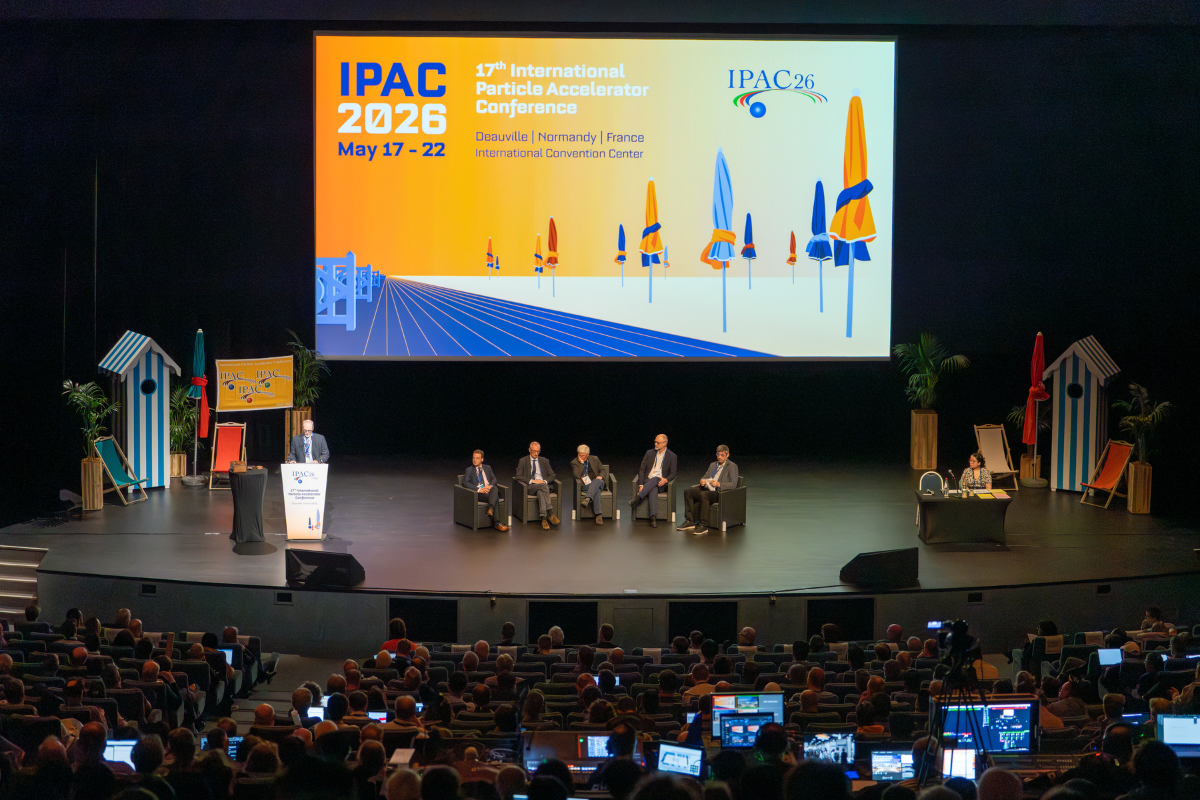
The accelerator science and technology communities from around the world gathered in a vibrant and successful week at the 17th International Particle Accelerator Conference (IPAC’26), held from May 17–22 in Deauville, France.
The event was hosted and organised by the GANIL laboratory in collaboration with CEA, CNRS, Synchrotron SOLEIL, ESRF along with the European Physical Society Accelerator Group.
It once again demonstrated IPAC’s role as a leading international meeting for accelerator scientists, engineers, and industry, bringing together more than 1,500 delegates from 41 countries. This is the largest number of countries represented for any IPAC conference in history.
An impressive total of 240 students attended the conference, of whom 96 were awarded scholarships which included conference attendance fees, accommodation, a per diem to cover living costs during the week and a contribution to travel costs.
For the first time in the history of IPAC, all students attended the IPAC’26 Student Tutoring programme on Saturday before the official conference start, whilst also presenting their work during a special student poster session on the Sunday afternoon.
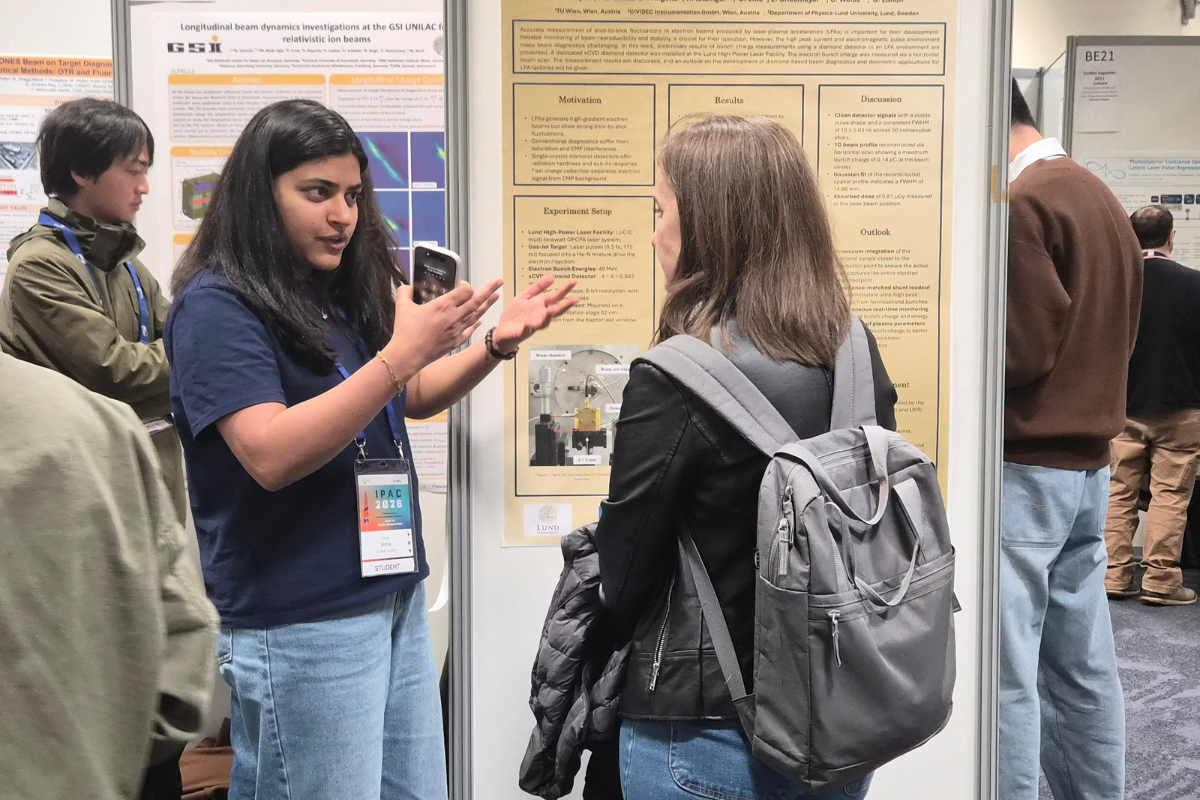
Throughout the week, participants exchanged insights on the latest breakthroughs in accelerator science and technology, showcasing the progress of current facilities and the visions guiding future developments.
International Organising Committee Chair Peter McIntosh commented: “It has been an incredibly rewarding and proud experience for me to have been the International Organisational Chair for IPAC’26, working alongside so many truly outstanding collaborating teams to have successfully organised and delivered such a major conference of this scale. I very much hope that the extensive engagements and collaborations which have been experienced throughout the week here in Deauville will leave a lasting and meaningful legacy for the accelerator community for years to come.”
With strong international representation and a record of 35% female speakers, the conference reflected the growing diversity of the community, while the special evening event on Equal Opportunities attracted more than 350 participants.
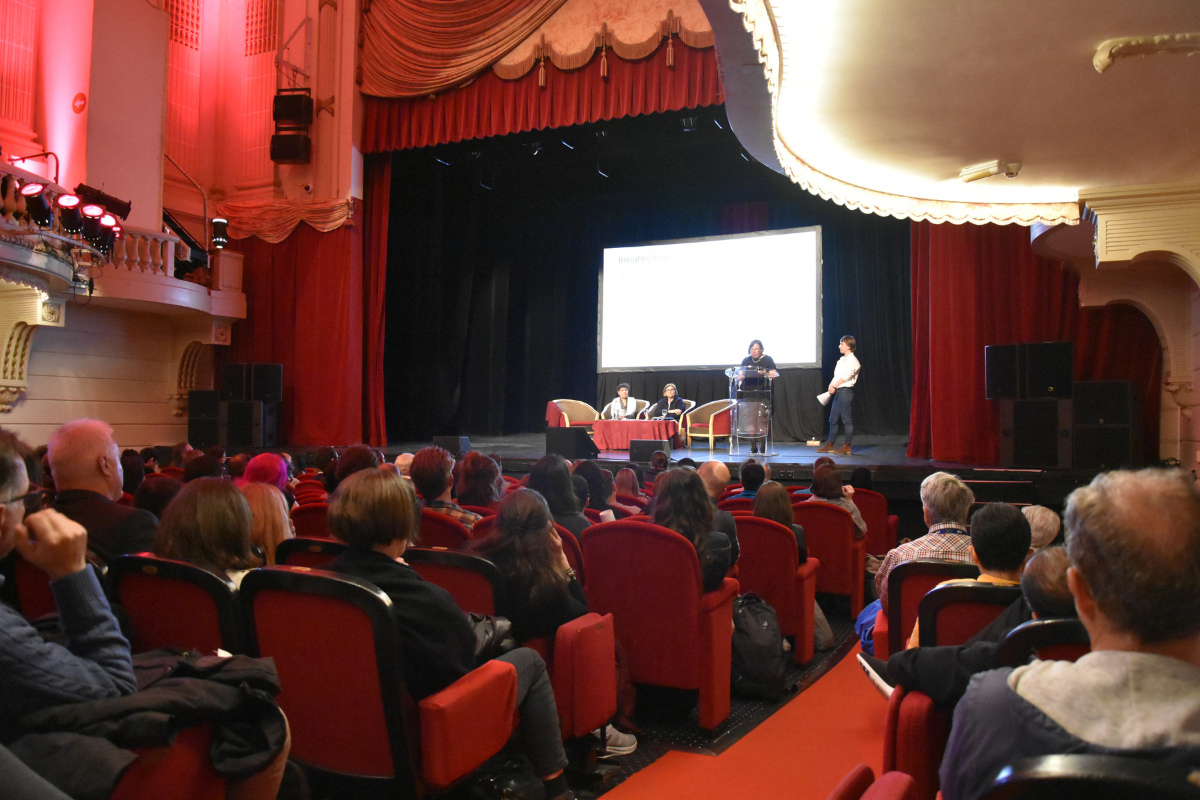
The scientific programme presented new projects, innovations, first-ever achievements, records and more. Over 1,400 submitted papers were edited by the JACoW team during the conference.
Mark Thomson, director-general of CERN, was one of the first speakers and gave a detailed insight into CERN’s future vision and strategic priorities. He highlighted that the highest priority for European particle physics remains the High-luminosity LHC whilst in the longer-term, the Future Circular Collider (FCC-ee) has emerged as the clear preference from the particle physics community for the next flagship collider at CERN after HiLumi LHC.
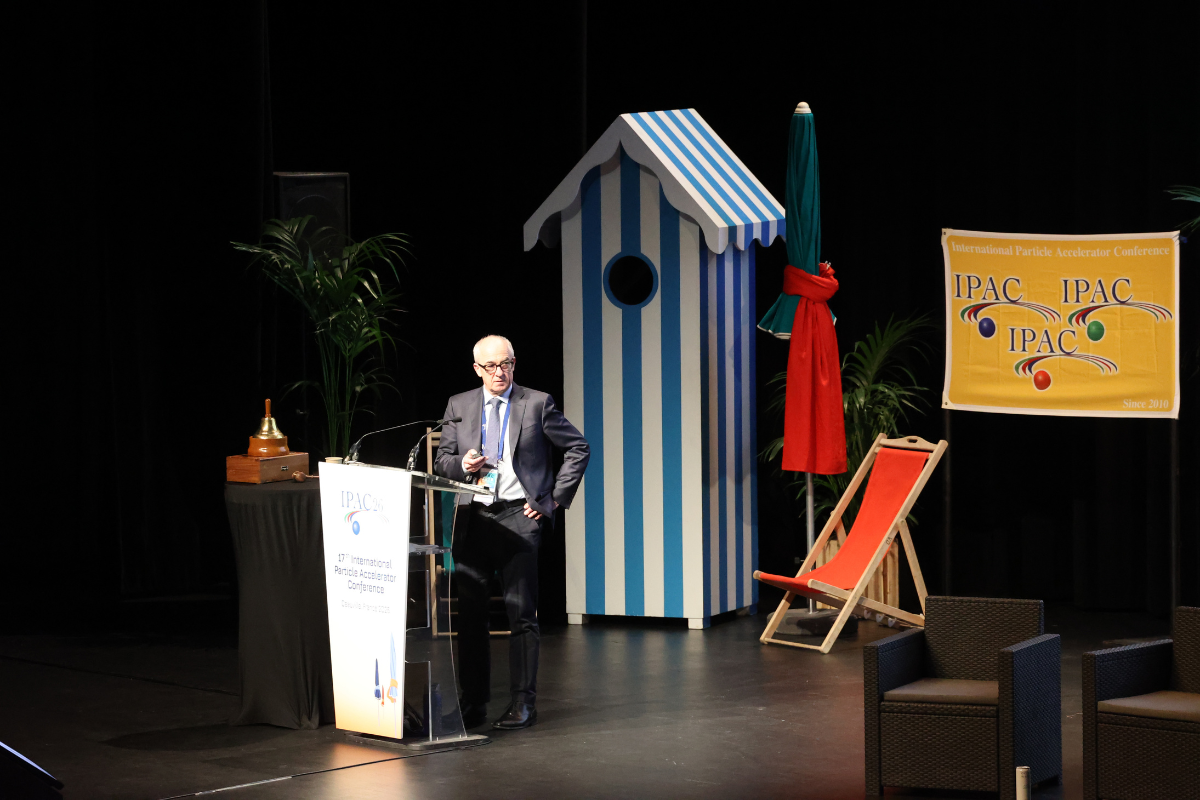
A series of talks summarised recent progress made at accelerator facilities around the world, including one from Michiko Minty from Brookhaven National Laboratory in the US about the Relativistic Heavy Ion Collider, which closed recently after a quarter century of colliding beam operation.
Scientific breakthroughs were also discussed in detail in the programme, including a presentation by KEK’s Masashi Otani on the first acceleration of positive muons.
In terms of novel acceleration techniques, there were a number of interesting contributions, including talks by Brigitte Cros from Université Paris-Saclay about high-quality electron beams with tuneable energy produced by laser plasma acceleration, and Aaron Liberman of the Weizmann Institute who discussed breakthrough in the first direct observation of a wakefield driven by structured light.
Scientific Programme Committee Chair Rogelio Tomas said: “We are thrilled to have delivered a vibrant, diverse scientific programme packed with groundbreaking innovations and historic firsts for the accelerator field."
The conference also featured a memorable award session. The European Physical Society Accelerator Group (EPS-AG) sponsored four accelerator awards at IPAC’26. The Rolf Wideröe Prize was awarded to Elena Shaposhnikova (CERN) for her outstanding contributions to RF systems, longitudinal beam dynamics, and impedance identification techniques. The Gersh Budker Prize went to Wentao Wang (Shanghai Institute of Optics and Fine Mechanics) for pioneering achievements in laser-plasma acceleration, including the first demonstration of free-electron lasing driven by a laser-plasma-generated beam. The Frank Sacherer Prize was awarded to Patrick Rauer (DESY) for leading the first experimental demonstration of a cavity-based XFEL at the European XFEL and developing advanced simulation tools. The Bruno Touschek Prize was presented to Andrea Frazzitta (Sapienza University of Rome & PSI) for his innovative PhD work, including the invention of the Plasma Discharge Undulator, a novel concept for plasma-based radiation sources.
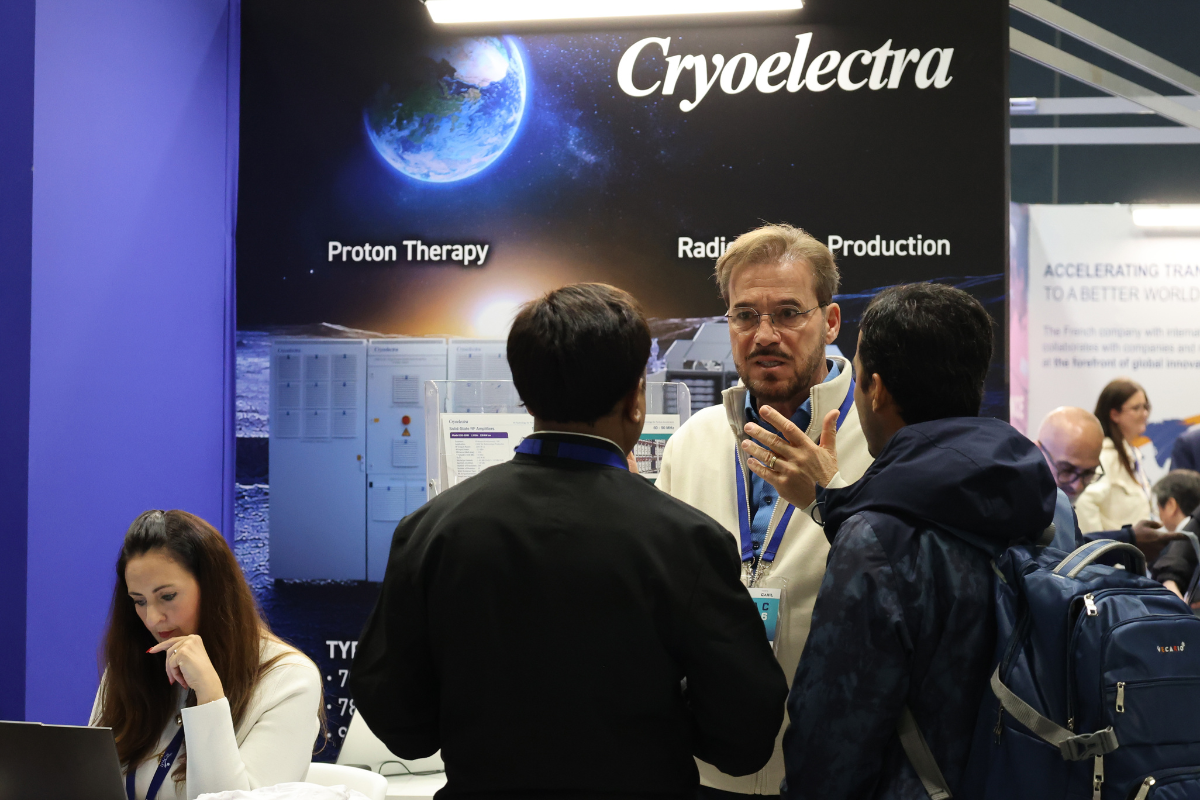
The conference also featured a large industrial exhibition with more than 120 exhibitors, offering insights into current technology and instrumentation. It provided space for collaboration between research institutions and industry partners.
Local Organising Committee Chair Hanna Franberg-Delahaye concluded: “As the Local Organising Chair, it was a tremendous honour to welcome over 1,500 participants, including many students, and 120 industrial exhibitors to Deauville, Normandy in France for IPAC’26. The journey began in November 2021, and the week itself was filled with vibrant meetings and discussions between the sessions, that brought together global expertise, fostering innovation, connection, and lasting memories. The energy and engagement throughout the week reaffirmed our commitment to advancing the accelerator community, and I am deeply proud of what we achieved together.”
The next European IPAC, IPAC’29, is scheduled for 20-25 May 2029 in Liverpool, UK.